Simucube Link Platform: Turning complex sim racing setup into one predictable system

At Simucube, everything starts with trust. When you turn the wheel, the feedback must be precise, repeatable, and predictable every time. Modern racing simulators became packed with multiple steering wheels, high-end pedals, force feedback wheelbases, dashboards, button boxes, hubs, and long USB chains. Power strips multiplied, and the simple thing of starting a session turned into a sequence of checks and small risks that only appear when something stops working.
Simucube Link Platform is our answer to that growing complexity. It is not another stack of devices. It is a complete rethink of how the racing simulator connects, communicates, and behaves as one system. Instead of separate parts tied together with cables and consumer-grade USB pathways, the entire racing simulator becomes a single machine with one internal language, one brain, and one predictable set of rules.
Why now?
We could have proposed a similar architecture earlier, but two elements weren’t yet where they needed to be:
- Maturity of real-world use
Today, many racing simulators have evolved into highly professional setups with active pedals, advanced dashboards, telemetry software and dedicated sim centres with multiple simulators. The need for a more organised architecture is no longer theoretical – you see it every day.
- Accumulated learnings from support and field use
Years of listening to real problems have shown us where things fail and which design decisions truly reduce those failure points.
Today, as simulators evolve into complex, multi-device systems, USB stability and interference have become common challenges across sim racing. Our Customer Experience team regularly works with customers who report force feedback fading, unexpected disconnects or other behaviour that only appears in complex, multi-device setups.
They frequently receive customer feedback describing troubleshooting processes that many sim racers will recognize:
“I started disconnecting different peripherals to see if there was a conflict. Once I disconnected the motion rig, the force feedback loss stopped.”
“I am very aware of EMI-related issues and already had filters, large ferrite cores and proper grounding in place.”
“After installing a USB isolator and testing for several hours over the past week, the problem seems to have vanished.”
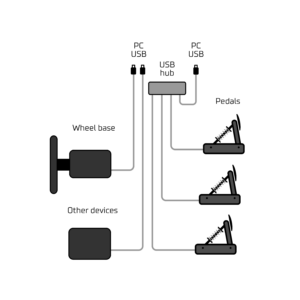
Every device in the racing simulator is connected to the PC as a regular USB device. That brings obvious advantages such as a well-known standard and mature drivers, but it also creates consequences:
- The setup becomes unpredictable. Each user chooses their own ports, hubs, and power solutions.
- Noise & Interference. Long USB cables in a metal rig with motors (for FFB or motion) increase the risk of EMI interference, ground loops and noise-induced disconnects.
- USB traffic can become unpredictable. A single hiccup on the USB bus may interrupt other devices, even those unrelated to simulation.
- Troubleshooting becomes guesswork. A failure might come from a cable, a hub, a controller, the operating system, or the power-up order.
As long as the base was the only complex piece in the system, this was reasonable. But as soon as active pedals appear, wheels with more electronics, and new devices that need very consistent response times, the architecture stops being just a technical detail and becomes a limitation.
With Simucube 3, simply creating a “better wheelbase” wasn’t enough. We set out to define the entire critical path and how every part interacts, building a system engineered for long-term reliability.
Core goals of Simucube Link Platform
- Reduce pre-race complexity. Fewer decisions about what plugs into where, fewer power-on routines, and fewer surprises.
- More coherent system behaviour. Sim racing pedals, wheelbase and steering wheels should behave like parts of a single system, not like independent devices that happen to share the same racing simulator.
- Provide a long-term foundation for future products and features. One of Link Platform’s goals is to give partners a clear way to integrate without losing own identity. If a device carries the Link badge, it integrates natively with Simucube 3 and other Link products, you may trust that device is reliable and will work for a long time as expected.
The “One-Click Race” experience
Everything in Link Platform focuses on one goal: sit down, power on, drive.
| Before Link Platform | With Link Platform |
| Manual power sequence, USB problems, wheel battery checks | One power switch, the racing simulator wakes up in order, profile loads automatically |
What Link Platform is not, and this is worth stating clearly, it is not a promise of absolute simplicity or the removal of all complexity. An advanced racing simulator is still a sophisticated system, and there will always be some level of tuning and configuration. The difference is that from now on, the complexity is designed and structured inside the platform rather than growing organically around a collection of USB devices.
The Five Pillars of Simucube Link Platform
Simucube Lightbridge
Simucube LightBridge is a technology for contactless transmission of both data and power, built directly into the wheelbase electronics. It enables power and data transfer between a compatible steering wheel and the wheelbase via the quick release interface.
It’s a professional-level technology that delivers power and data with zero wearing parts, designed and engineered by Simucube exclusively for sim racing.
In simple terms: you attach the wheel to the base, and everything just works. There’s no need to connect a USB cable or use a wireless dongle. The coupling itself supplies power to the sim wheel’s electronics and transmits all data — for buttons, paddles, displays, LEDs, and other components — through the connection itself.
More about Simucube LightBridge
Simucube Link Hub
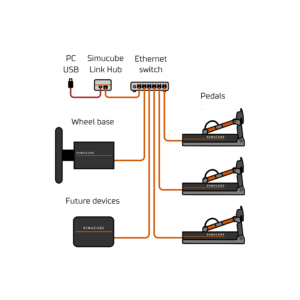
Instead of sim racing pedals, high-end wheelbases and other devices fighting for USB ports, a single device — Simucube Link Hub — connects to the PC and manages the racing simulator’s internal network. It routes all links to the direct drive wheelbase, active pedals, and other Link devices of you racing simulator, while also handling firmware updates and system configuration.
Link Hub is the heart of the platform and becomes the racing simulator’s gateway to the PC.
More about Simucube Link Hub
Simcube Link Wheel Module
Simucube Link Wheel Module is a hardware module inside the steering wheel that speaks the “Link language” on behalf of the wheel. The idea is simple. When the Simucube name is on the device and in the documentation, the experience across the entire racing simulator must meet that trusted standard. At the same time, the sim racing industry is driven by specialised wheel makers, sim racing partners, and advanced DIY projects. This is where the Link Wheel Module matters.
The module gives manufacturers a direct path to native Link integration without redesigning base-side electronics, turning a steering wheel into a true Link-native device. For the sim racer, the Link badge signals reliability you can trust and long-term support. And the module never forces you to give anything up — whether through USB or Simucube Wireless, it simply opens the door to deeper integration.
You can use all your existing wheels with Simucube 3. Click here to see how to choose the right steering wheel for Simucube 3.
Simucube Tuner 3.0 software
Simucube Tuner 3.0 is the command console for Simucube Link Platform’s internal network. From there, you can discover Link products, manage profiles, and handle firmware updates.
More about Simucube Tuner 3.0 software
Simucube API
Simucube Link API (sc-api) is an alpha-stage programmable interface for interacting with Simucube hardware and Tuner software. It provides developers with a precise, programmable path into Simucube and Simucube Link-compatible hardware, forming the foundation for next-generation sim racing innovation.
The API takes force feedback and telemetry integration to a deeper level, offering predictable access to system data, events, and configuration. While Simucube Link API is still in its early stages, this is your opportunity to contribute. Whether you are a developer or an enthusiast, you are invited to explore the alpha, share feedback, and propose new use cases.
More about Simucube Link API
Link Platform overview
So, how does it all come together as one system?
- The PC plugs into Link Hub with one cable. Link Hub is the system’s main connection point.
- The wheelbase connects to the steering wheel through Link Quick Release with contactless Lightbridge technology.
- A Link Wheel Module makes the steering wheel a native part of the platform.
- Simucube Tuner 3.0 connects through Link Hub to manage devices, profiles, and updates.
- The API lets other applications access the system for data, rig management, or advanced features.
The result is a racing simulator that behaves like one “organism” rather than a group of independent devices.
What Link Platform brings to everyday use
| A smoother start to every session | Sit down, power on, and drive. No cable checks, no guessing, no unexpected routines. |
| One system, working together | Link Hub replaces multiple USB devices with a single USB connection, allowing the wheelbase, pedals, and steering wheel to work together as one system |
| Clean, dependable connections | Lightbridge removes wheel-side cables, while Link Hub connects to the PC and manages the racing simulator’s internal network. |
| Stable performance you can trust | Reduced interference, fewer disconnects, and a structure designed for consistent behaviour under heavy use. |
| Straightforward control and updates | Tuner 3.0 keeps profiles, firmware, and device management in one place. |
| Confidence in every component | Link-compatible wheels integrate natively, while all existing USB and Simucube Wireless wheels continue to work without changing your setup. |
| A transition on your terms | You can adopt Link Platform step by step, upgrading when you want, without replacing everything at once. |
Read more blogs
A buyer’s guide to high-end sim racing wheelbase
Does gear really matter in sim racing?
Traxion x Simucube: How Simucube creates forever sim racing equipment
Differences between Simucube 2 and Simucube 3
Simucube 2: Legendary wheelbase, built to last